
Looking Back
Inspired by Elegant Lit's Melodies & Memories prompt for December. I found it interesting how many figures in myth and folklore involve "not looking behind."

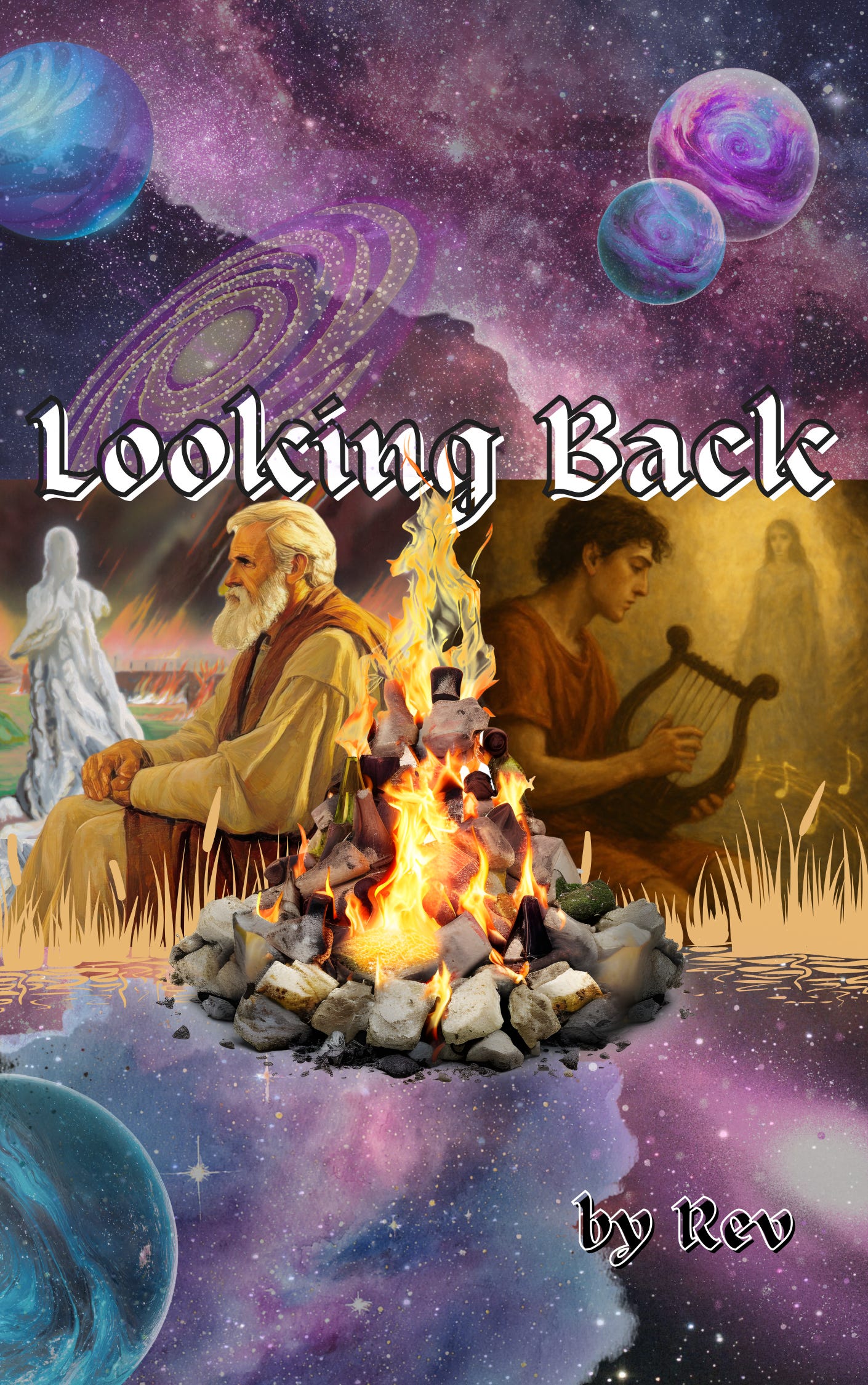
The Border Between realms of myths and dreams sits enveloped in peaceful darkness; a pane of ebony glass watching over reality with static stoicism.
And yet.
A ripple disturbs its placid surface. It settles.
Another, greater than before. It settles.
A third, vibrations casting electric webs across infinity, flashes of thoughts and hopes igniting unseen embers of matter and time, coalescing into something new—something necessary.
A planescape of Story and Lore asserts its fleeting existence in service to wandering legends in need. The island of potential floats within its own globe, itself drifting in the void of creation. This new realm bursts with passionate reflection.
Swirling pinwheels of platinum and periwinkle stars drift listlessly above an ethereal woodland, as towering firs stand sentinel over a small campfire playing host to a lone figure draped in crimson cloth. Lyre in hand and practiced fingers plucking, a melody as rich as lumber resin enchants the very air he breathes and emanates outward across the trees. It carries with it the memories of tragedy and regret. It carries with it the distilled sadness of grief. It carries with it the pain felt deep within one’s soul when what once was can never be. Yet, in defiance of the song, the man’s face is plagued with peace.
“In all my years, I have never felt a melody pierce through my core like the divinity I hear now.” An older traveler, adorned in an earthy tunic and cloth-wrapped feet, approaches the fire from the opposite end of the small clearing. “May I join thee?”
The musician ceases his song, and motions with one calloused hand toward a ragged stump nearby.
With a century-laced groan, the elder rests on the provided seat. “My gratitude, player. I fear I’ve not yet seen a quarter of this wood, though I know not why I wander it.” His aged lips, barely visible beneath a stark-white beard, smile.
The lyrist studies his visitor without a word. He sees the weariness of experience painted upon the old man’s face, flecked with tremendous joy and cavernous sadness alike—a canvas colored with a palette of living and losing. The stranger’s worn hands, held to the warmth of the flames, are delicate, as one with wealth may display.
“Are you,” the musician begins, “a man of status?” His voice rings as angelic as the tune he plays.
His guest thinks for a moment before answering. “I suppose I was. I did judge my fellow man for a time, though my city fell to ruin.”
The player nods knowingly; pain knows pain, after all, and the younger man sees the ache the elder wields in his spirit.
“Might I, as thy host, ask thee to ponder a ruling I have cast upon myself?” The young lyrist’s eyes sparkle with unborn tears.
The elder tilts his head to the man, noting his sparse clothing and pale features. “Aye, if thou wish to unburden thyself to an old official, I’ll happily attend thee. Tis the least I can do to repay thee for my respite.” He shuffles to face his host directly. “Tell me of this consequence the player has cast upon himself.”
The musician strums his lyre, once more warming the wood with wondrous sound. His song begins, memories unfolding with each note:
I play for thee my tale of woe
And of my penance served
I ask thou then, once thou dost know
If justice is deserved.
The home I called a land named Thrace
My music most renowned
The songs I sung filled all with grace
From man to legends crowned.
I married one of such delight
Her voice and visage pure
Eurydice, Oh what a sight!
With heart and charm demure
Our blissful day was not to be
For Fates had altered plans
My wife, her light, I sing to thee
Was doused by cruelest hands.
One bite of the ophidi’n worm
Brought low her loving life
And to the Underworld long-term
Was sent my loving wife.
And though I knew the odds were long
And though they said I’d fail
Olympus blessed me for my song
To let me in death’s jail.
My melody, it soothed them all
The dead, the hound, the gods
With hope in heart in hallowed hall
I’d beat those awful odds.
The King of Souls, Hades below
Was moved enough to act
“Take your wife back, you both may go
But hear this fateful pact:
“She’ll walk behind thee, so I say
And once you’re in the light
Soul in body will then inlay
Thou love and thee unite.
“But if thou fail to trust thy lord
And look back once to see
Pulled back, your wife will be my ward
You’ll lose Eurydice.”
I’d only need to trust the god
And happy we would be
But I, my friend, am human flawed
My fear defeated me
Mere steps away, the light in view
Silence filled my caution
I only glanced, though then I knew
She began to soften
I cried out to her as she melt
Her eyes said “Tis alright”
When gone the emptiness I felt
Was more than gods could fight
This singer searched for solemn end
And wishing to be gone
But once deceased, to make amend
He cursed himself “Go on.”
And now, poor lyrist dwells and plays
Around this solemn plane
Asking of thee, oh judge of days
Is Orpheus to blame?
The last notes dissipate into the cosmic vortices above, haunting the pair with a bubbling stream of silence. The old man, his eyes closed long ago in loving rapture of the melody, shuffles once more to face the campfire. He opens his eyes and seeks answers in the crackling pyre.
Orpheus sets his lyre down and lies back to lose himself in the infinite, awaiting his guest’s judgment.
A breeze, salty and hot, fans the flames passing through. The elder, sensing the saline scent, feels his answer form.
“I have a tale myself, though I’ll be brief. I know thou wouldst like an answer to thy query.”
The musician, reclined as he is, takes his turn to lower his lids and listen.
The stranger sinks into his own memories and begins:
“My uncle and I were herdsmen, for a time, though we often didn’t agree. Despite warnings, when we parted, I chose to settle near a city named Sodom. I was certain of the wealth we would earn in the area, for it was a wicked town of sin and disgrace, and I, and my family, embraced life within its borders.
“While I argue that we never partook in the villainy of Sodom, I, as an official and judge, did little to condemn the saturation of sin and vice. Those in power who remain silent as wickedness flourishes are equal in guilt.
“My conscience eased when I allowed strangers into my home, offering food and comfort away from thieves and deviants. Alas, my neighbors came calling and demanded I sacrifice my guests to them for the business of sullying their innocence. A consideration, I am shamed to say, I considered. Instead, I offered my virgin daughters.
“The strangers revealed themselves to be angels and warned me of the impending cataclysm that would raze Sodom to the ground. We were to flee, never looking back as the city of material wealth vanished into legend. My wife, however, had grown accustomed to our luxury. She couldn’t help but look back to see what might remain. As I stood behind her, I watched my love become a pillar of salt, for she had not the fortitude of faith to trust the angels’ word.
“Yet, I understand her folly and may have easily fallen to such temptation myself had she not simply been swifter to act. It is within us all to look back when doing so would be so perilous.”
Orpheus opens his eyes, pensive breaths steady and receptive. His tousled hair spilling across his brow and ears.
“I am Lot, and thou hast asked me to rule on thy self-imposed punishment.” The old man stands up, creaking joints and weary shoulders rebelling in tow. “Orpheus of Thrace, husband of Eurydice, musician of the gods. I, Lot of Ur of the Chaldees, nephew of Abraham, official of Sodom, charge thee of a most heinous crime: Being human.”
The musician rises, smiling.
Lot continues in a boisterous, if not overly clear, cadence: “Thou art sentenced to remember, for only in memory will we forgive our transgressions.”
Orpheus lifts his lyre once more. “Very well, sir. I shall endeavor to forgive my humanity, with all its flaws.”
“And celebrate its wondrous ways as well, for only a human who feels the love thou hast could ever make such a journey, eschewing their own life, simply for a chance to revive a partner.” The elder puts a hand on the young lyrist’s shoulder. “And do not falter when thou hast setbacks, for there will be setbacks.”
Orpheus plays another chord; the sky ripples in approval. “The song shall not end, Lot. I will sing until Eurydice and I are united once more.”
A final wave washes across the heavens as the notes signal satisfaction. The Border Between begins to reclaim its peace, and the island acquiesces. Both legends sense their imminent parting and smile.
The old man ambles toward the tree line, returning to his own journey. “Thy music truly buries itself within one’s soul. If thou never cease—”
“—thou need not look back, for the song will carry us onward forever.”